Granite
Granite reads as uniform from a distance and isn't — the finish and the block both decide how much of that actually shows.
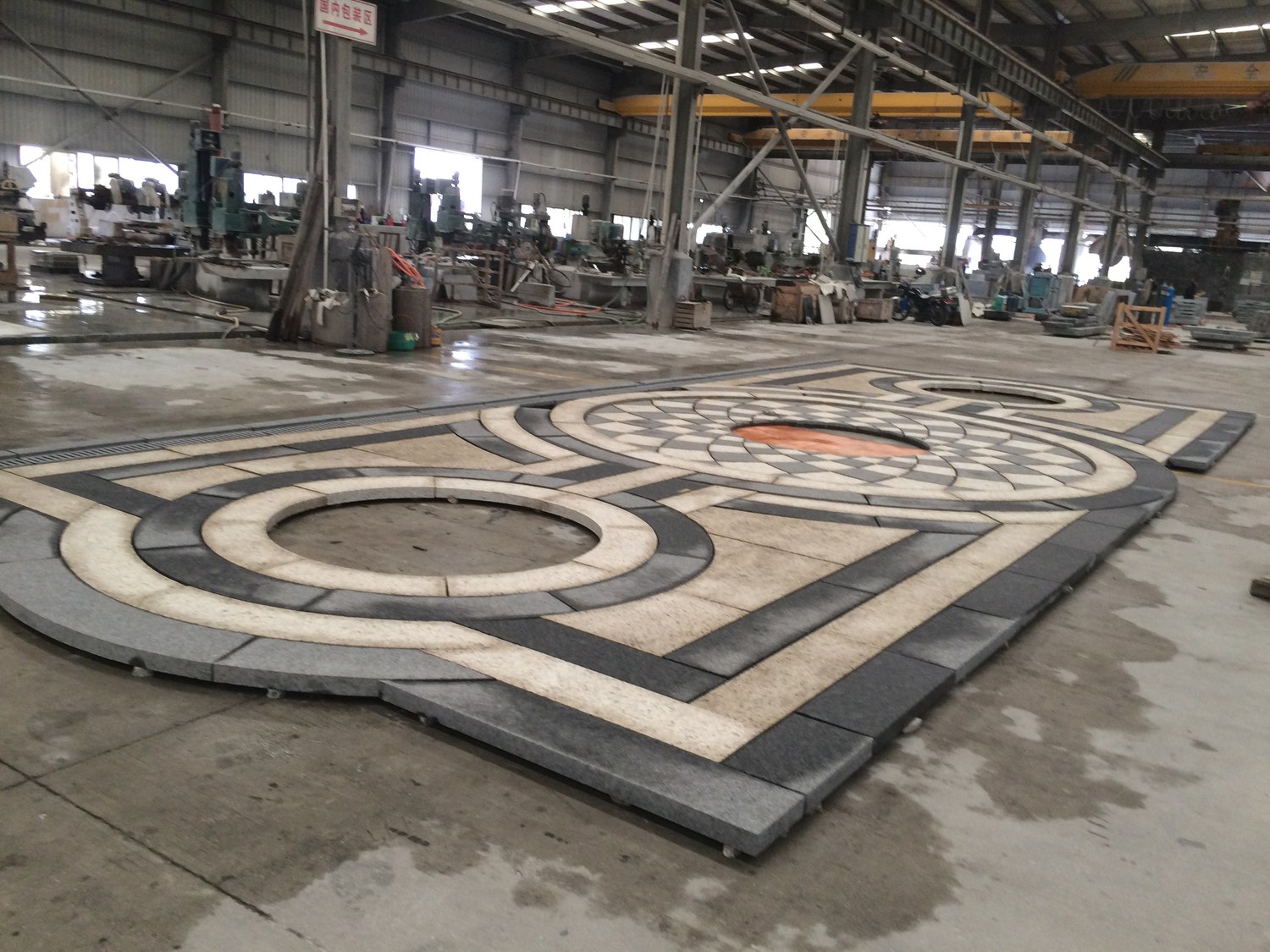
Harder and more stable than marble — not more uniform.
Granite is an igneous rock, harder, denser and more chemically stable than marble, but that doesn't make it uniform. Mineral distribution — quartz, feldspar, mica — shifts through a single block the way it formed, so a piece cut from one end can carry a visibly different grain pattern than a piece cut from the other. The finish chosen changes how much of that variation actually shows: a polished surface reveals colour and mineral contrast that a flamed or bush-hammered finish flattens out.
This matters most on repeat and pattern work — a paving medallion, a series of matching steps, a run of cladding panels — where consistency across many pieces, not just one showroom sample, decides whether the finished project reads as intentional or patchy.
Five checks, and what each one is actually judged against.
Block selection and mineral pattern
Blocks are checked against the approved sample before cutting, tracking how grain size and mineral distribution move through the block — not just at the single face that was polished for approval.
Cutting direction and yield
Cutting direction is planned against the finished pattern before the saw runs, particularly on repeat or medallion work, where a wedge cut the wrong way throws off every piece that follows it.
Finish and slip resistance
Flamed, bush-hammered, sandblasted and honed finishes are checked for slip resistance and colour change against the specified sample — not assumed from the finish name alone. Flamed granite from two different blocks can still read differently.
Thickness and structural suitability
Thickness is checked with a caliper against the load the application calls for. Paving and heavy-traffic surfaces are held to a thicker standard than wall cladding — not the same specification used for both.
Outdoor performance
UV stability and freeze-thaw exposure are checked against the destination climate before the material ships, not assumed universal — the same granite performs differently in a heated interior lobby and an exterior installation through repeated winters.
A paving medallion, from layout logic to finished piece.
The layout logic first, then South African Black and Giallo Santa Cecilia worked into the finished piece on the factory floor.
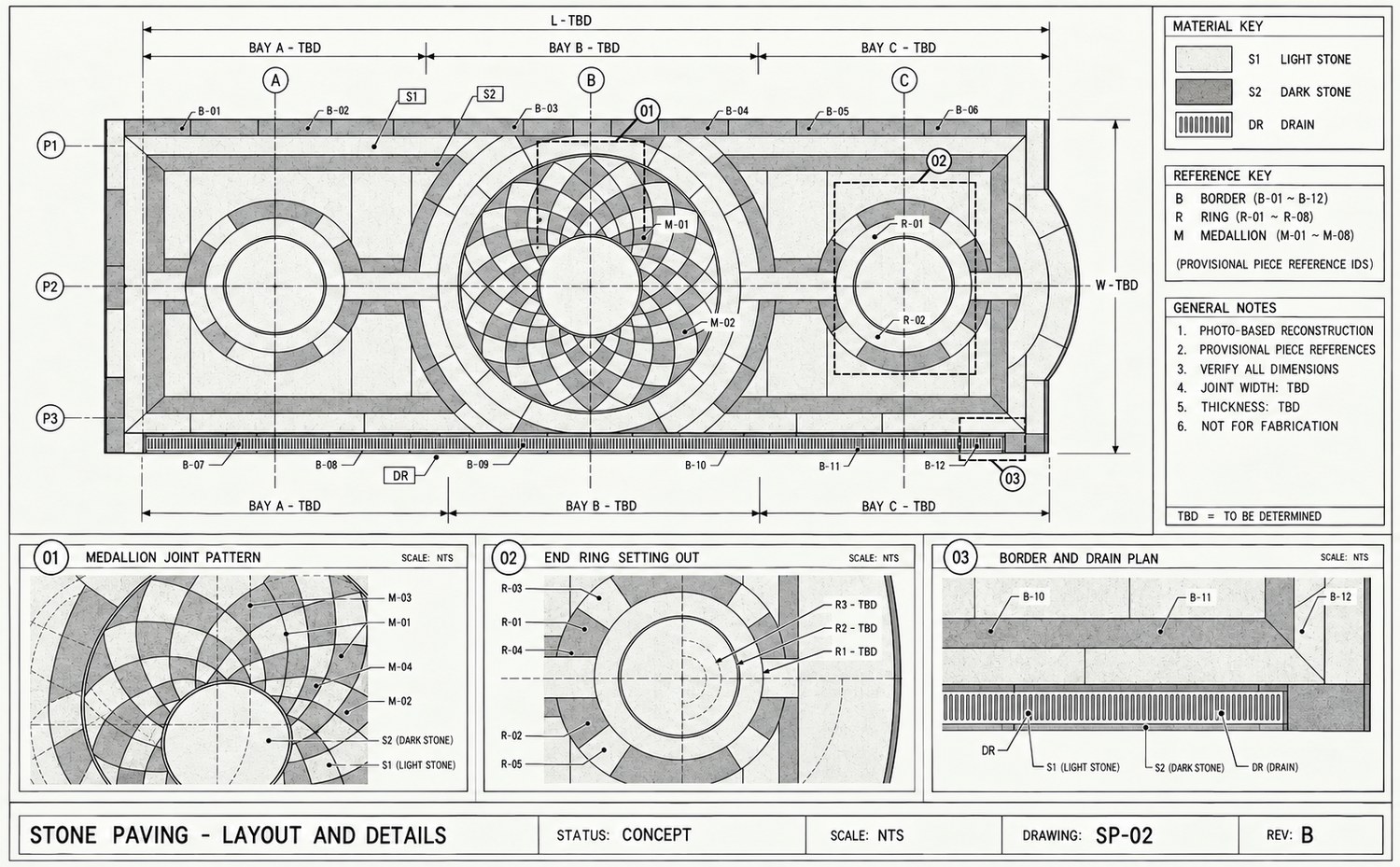
Layout logic, mapped from the finished piece
A schematic reconstruction of the medallion layout — bays, rings, borders and drain line — mapped out to document how the piece is organised. Provisional and for reference only; it is not the drawing used to fabricate this project.
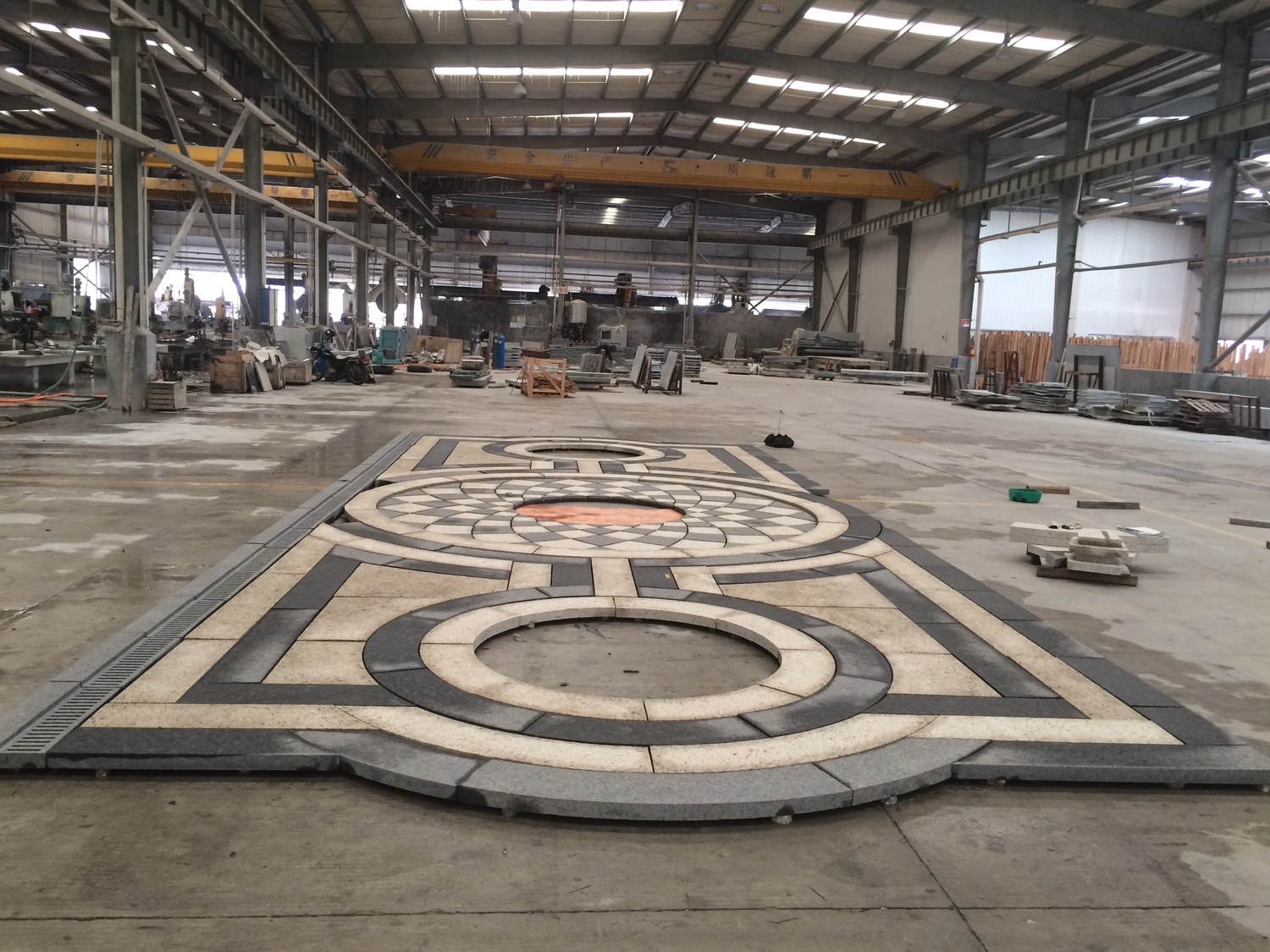
The medallion, dry-laid on the factory floor
South African Black granite forms the borders and radiating divisions; Giallo Santa Cecilia — the speckled cream-and-gold Brazilian granite — fills the medallion field. The complete piece was laid out before crating, so joint lines and pattern alignment could be checked against the full floor, not a small sample section.
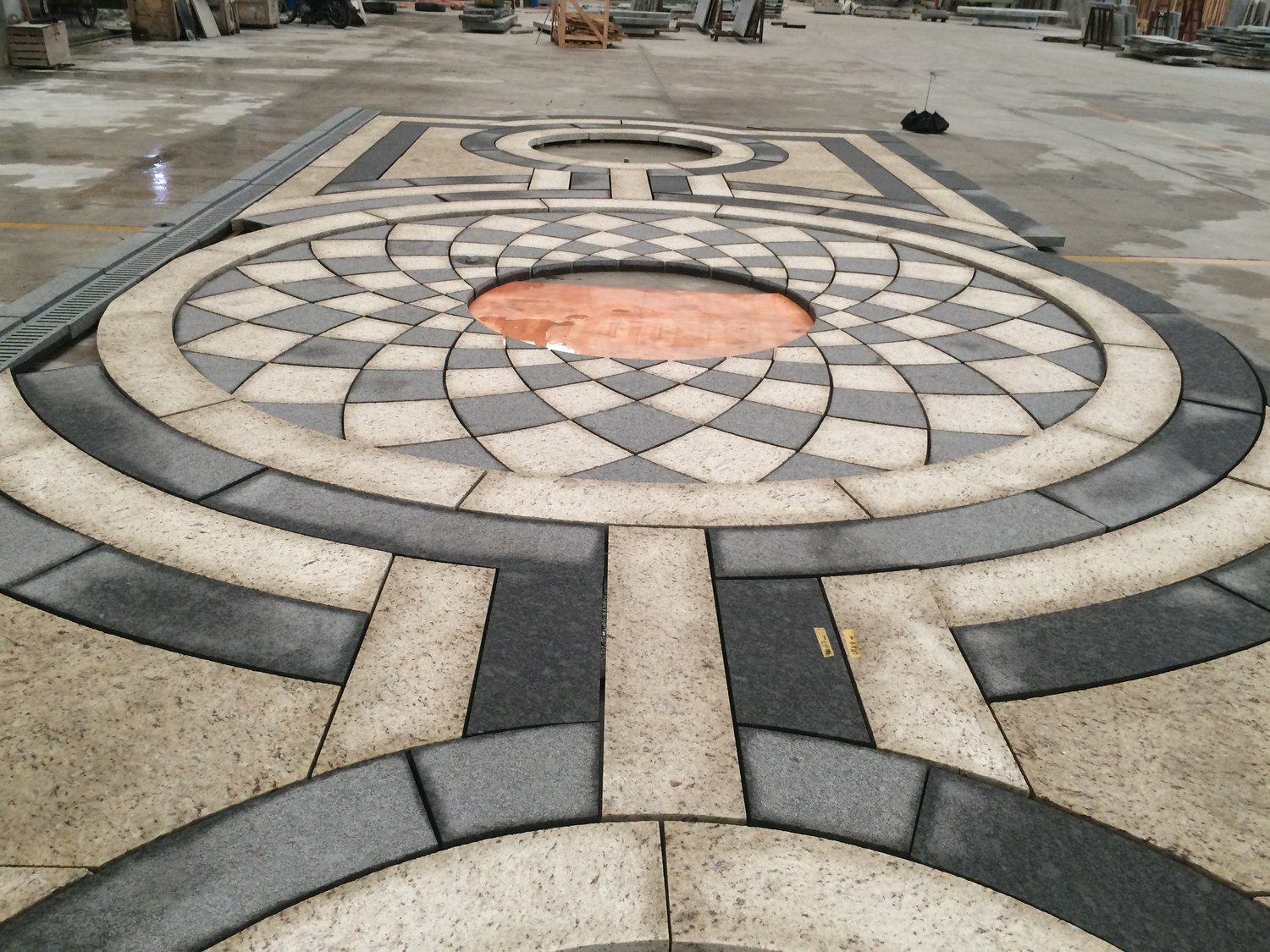
The fan medallion, piece by piece
A closer view of the radiating fan pattern at the centre of the design, alternating Giallo Santa Cecilia and South African Black in a curved joint pattern that widens toward the outer ring — every wedge cut and checked individually before it reached this position on the floor.
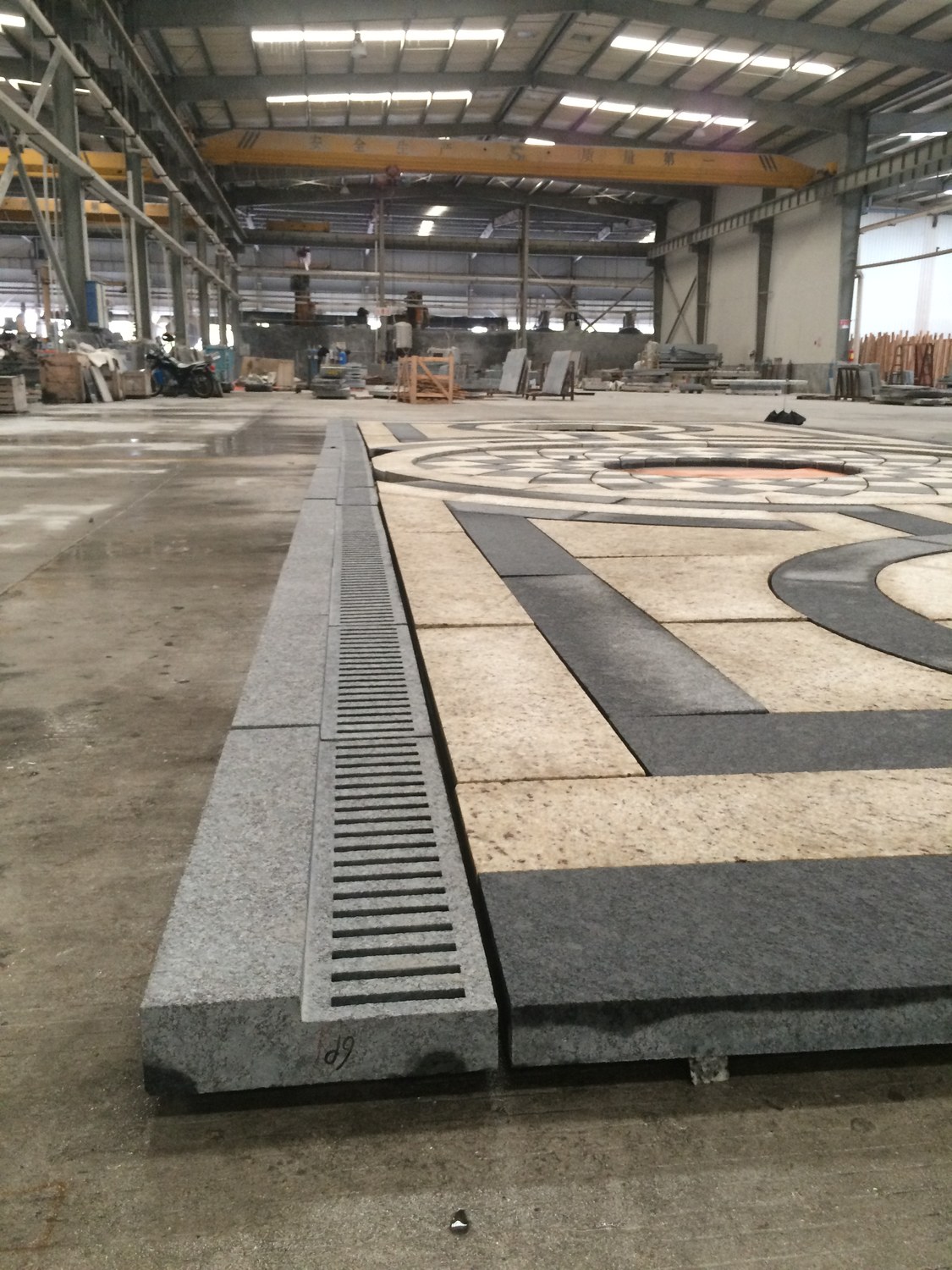
Border, drain channel and finished edge
The outer border in South African Black, with a stone-clad drainage channel running along the edge. Getting this detail right matters more than the medallion itself in an outdoor application — it's where water management and the finished edge condition either hold up or don't.
Where granite gets specified.
Countertops, paving, cladding, kerbs, steps, monuments, site furniture and engraved elements.
The risks concentrate around the environment and the joints, not the stone failing.
In exterior paving — like the medallion on this page — absorbed water expands as it freezes, and repeated freeze-thaw cycles decide whether the installation survives its first few winters intact. The finish and the bedding system both affect how much water the surface actually takes on.
Where granite is bedded onto a cementitious substrate or set into a wet-set exterior application, salts can migrate to the surface as efflorescence — a white bloom that's usually a bedding and moisture issue rather than a defect in the stone, though the stone gets blamed regardless. Polished and flamed finishes also change under years of foot or vehicle traffic — gloss dulls, texture burnishes — and slip resistance is worth re-testing periodically rather than assumed constant for the life of the installation.
None of this is a reason to avoid granite in exterior or heavy-traffic applications — it's the material built for them. It's a reason to agree the finish, drainage detailing and bedding system before installation, matched to the climate the project is going into.
The other five stone families.





Not sure whether the granite you've chosen suits the application?
That question is cheaper to answer now than after the container arrives. Send the material reference, the application and the environment, and we'll tell you what we'd want to check.