Sandstone
Carved in 713 AD, still standing 1,300 years later — this is what sandstone durability actually looks like when it's asked to prove it.

Rewards correct specification, punishes assumptions.
Sandstone is warm, matte and forgiving underfoot — which is exactly why it gets specified around pools, gardens and villa exteriors where a harder, colder stone would feel wrong. But it rewards correct specification and punishes assumptions more than most stone types. Get the bedding direction, absorption rating and sealing strategy right, and sandstone can outlast almost anything else in this guide — the Leshan Giant Buddha above has stood in the open air, through rain, humidity and the Sichuan sun, for over 1,300 years, without ever having been indoors. Get any of those decisions wrong, and the same material delaminates, stains or discolours within a few seasons.
That range — from a monument that survives more than a millennium to a paving stone that fails in three years — is entirely a function of how the material was selected, cut and installed, not the stone itself.
Five checks, and what each one is actually judged against.
Bedding plane direction
Bedding direction is checked and marked before cutting, not assumed from the slab's face. Laying a piece against its natural bed, rather than with it, causes the layers to delaminate under weathering — often years after installation, once it's too late to trace the decision back.
Absorption and salt sensitivity
Absorption is tested against the destination environment, especially near pools, coastal sites or anywhere de-icing salt is used. A sandstone that performs well inland can absorb and hold salt in a coastal or poolside application, accelerating surface breakdown.
Batch colour consistency
Batches are checked against the approved range sample in daylight, not factory light. Sandstone moves in tone more than most buyers expect between blocks and quarries — even from the same named source.
Calibration and thickness tolerance
Thickness and calibration are checked across the full paving quantity, not a handful of pieces. A paving run depends on consistent joint lines across hundreds of units, not just individual accuracy.
Sealing strategy
Sealing is agreed and tested on an offcut before it's applied to the whole project. The wrong sealer can change the stone's colour permanently, and once it's on a finished floor there's no undoing it.
From colour range to carved relief.
The same family of stone, checked for range, traced by reference number, and worked into mouldings, coping and carved panels.
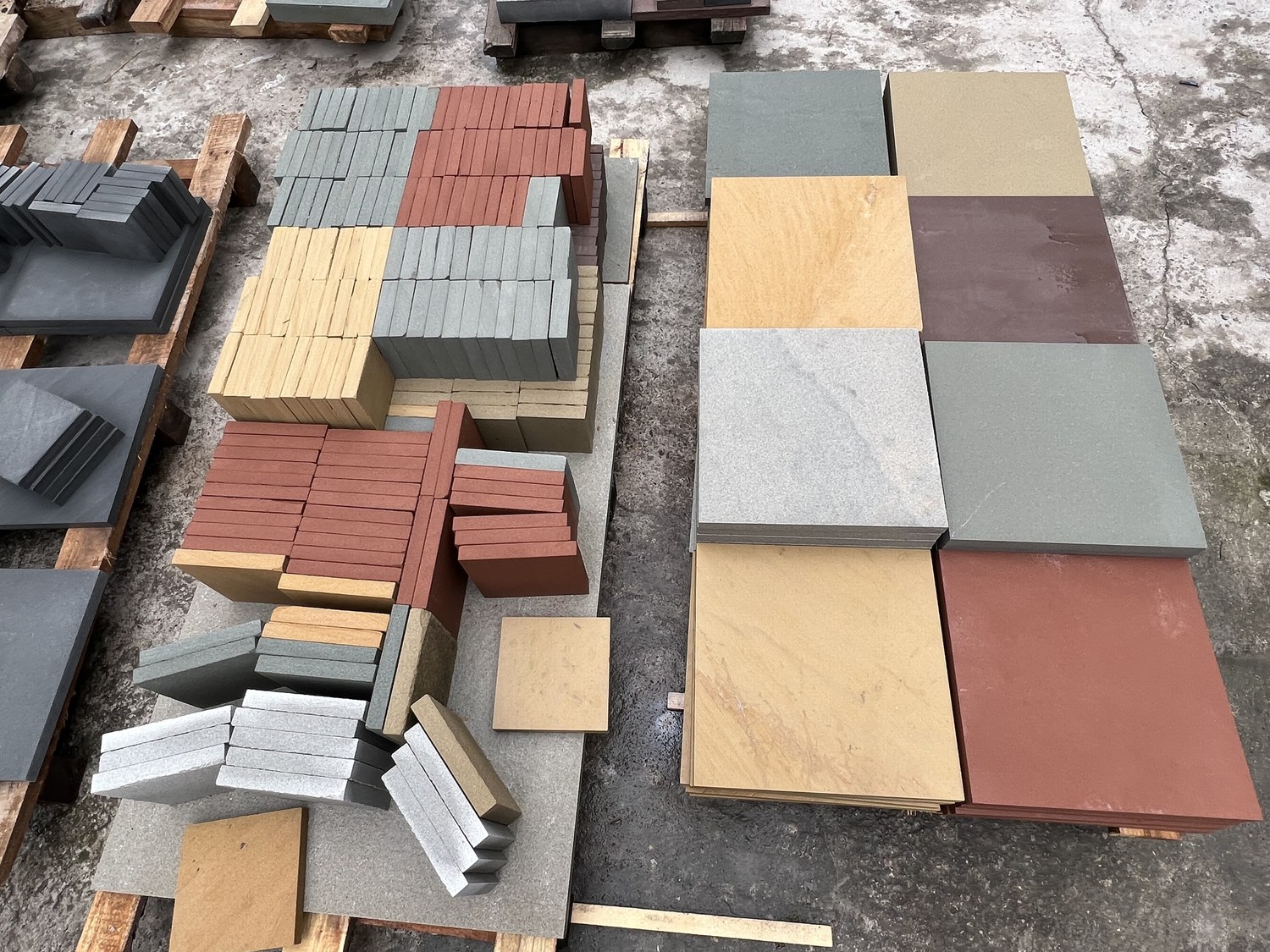
The colour range, laid out for comparison
Grey, tan, beige, plum and red sandstone side by side — the same family of stone can move across this entire range depending on the quarry and the block. Comparing the full range against the approved sample, in real light, is how batch drift gets caught before it ships.
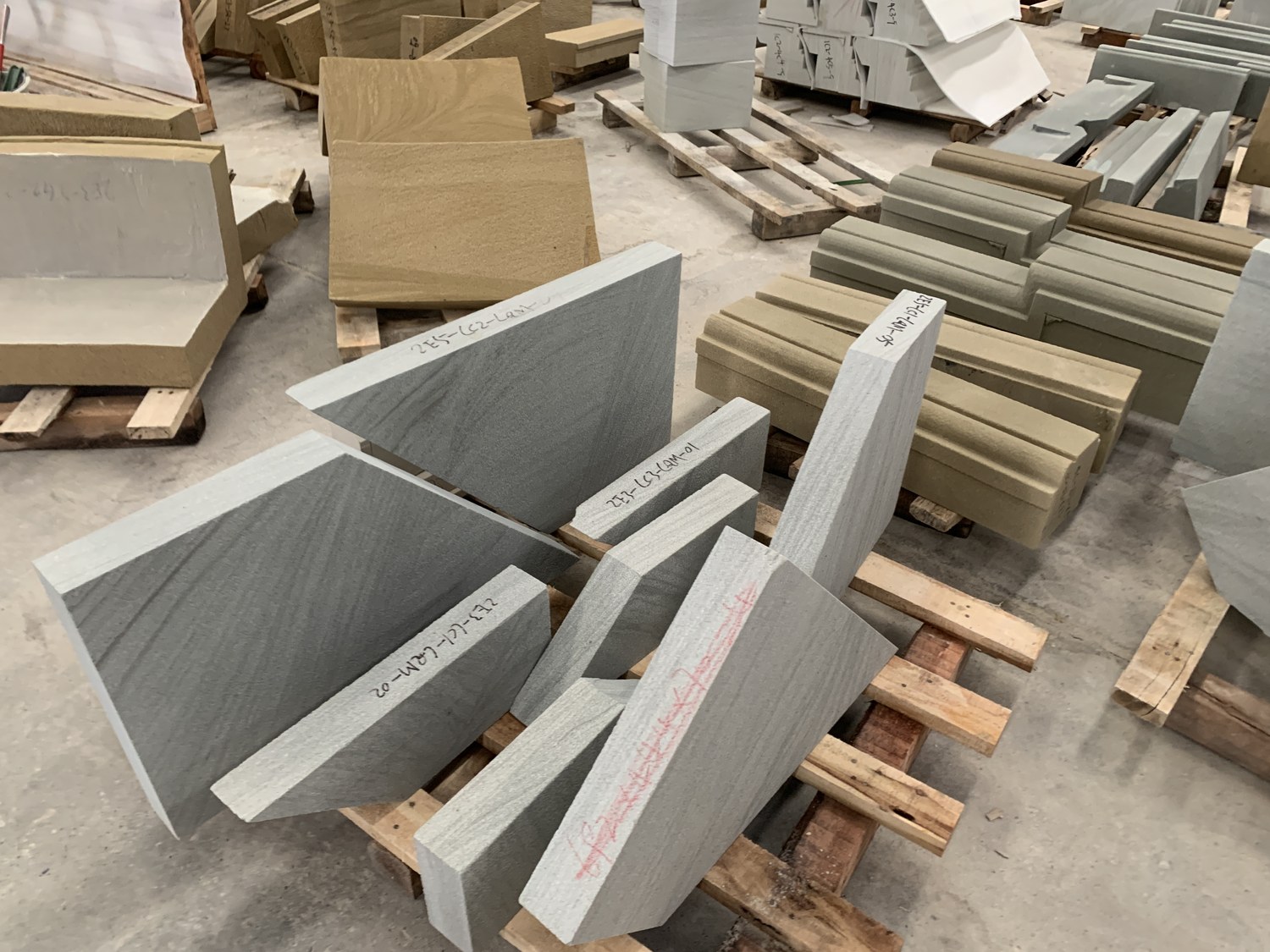
Cut pieces, tracked by reference number
Each cut piece is marked with a reference code and kept with its pallet, so a specific piece can be traced back to its batch and block if a question comes up later in the project.

Mouldings and medallions, cut and carved
Decorative profiles and carved floral medallions alongside plainer moulding stock — sandstone's workability is what makes this kind of detail affordable at scale, where the same shapes in granite would cost far more to cut.

Finished coping and kerb profiles, ready to ship
Arched coping stones and kerb sections in a light, even tone, finished and staged in the yard. Consistency across a run like this is checked piece by piece, not just at the sample stage.
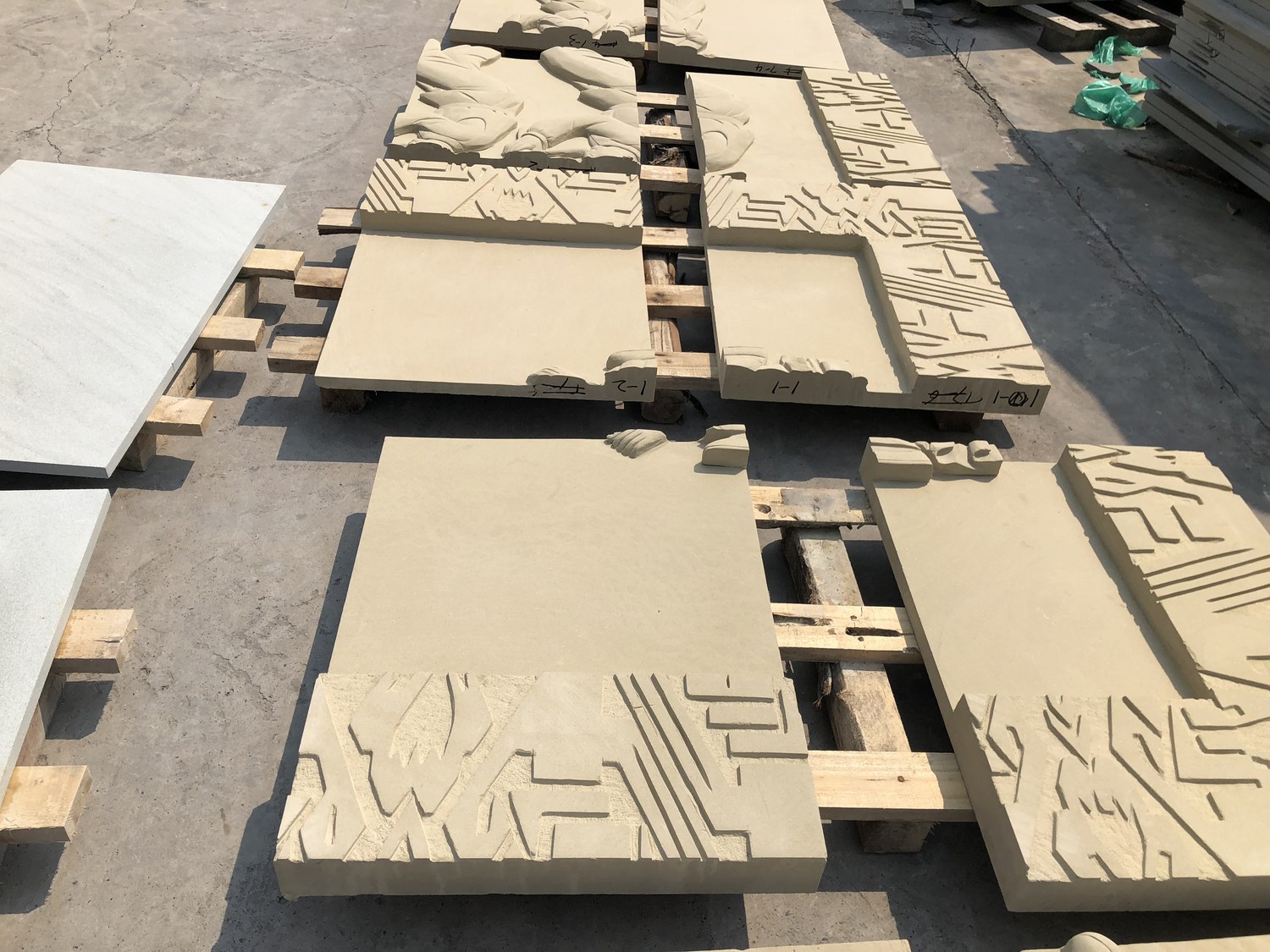
Carved relief panels, cut to depth
Architectural relief carving cut directly into sandstone panels — geometric and figurative patterns worked to a consistent depth across each panel before they're matched and installed as a set.
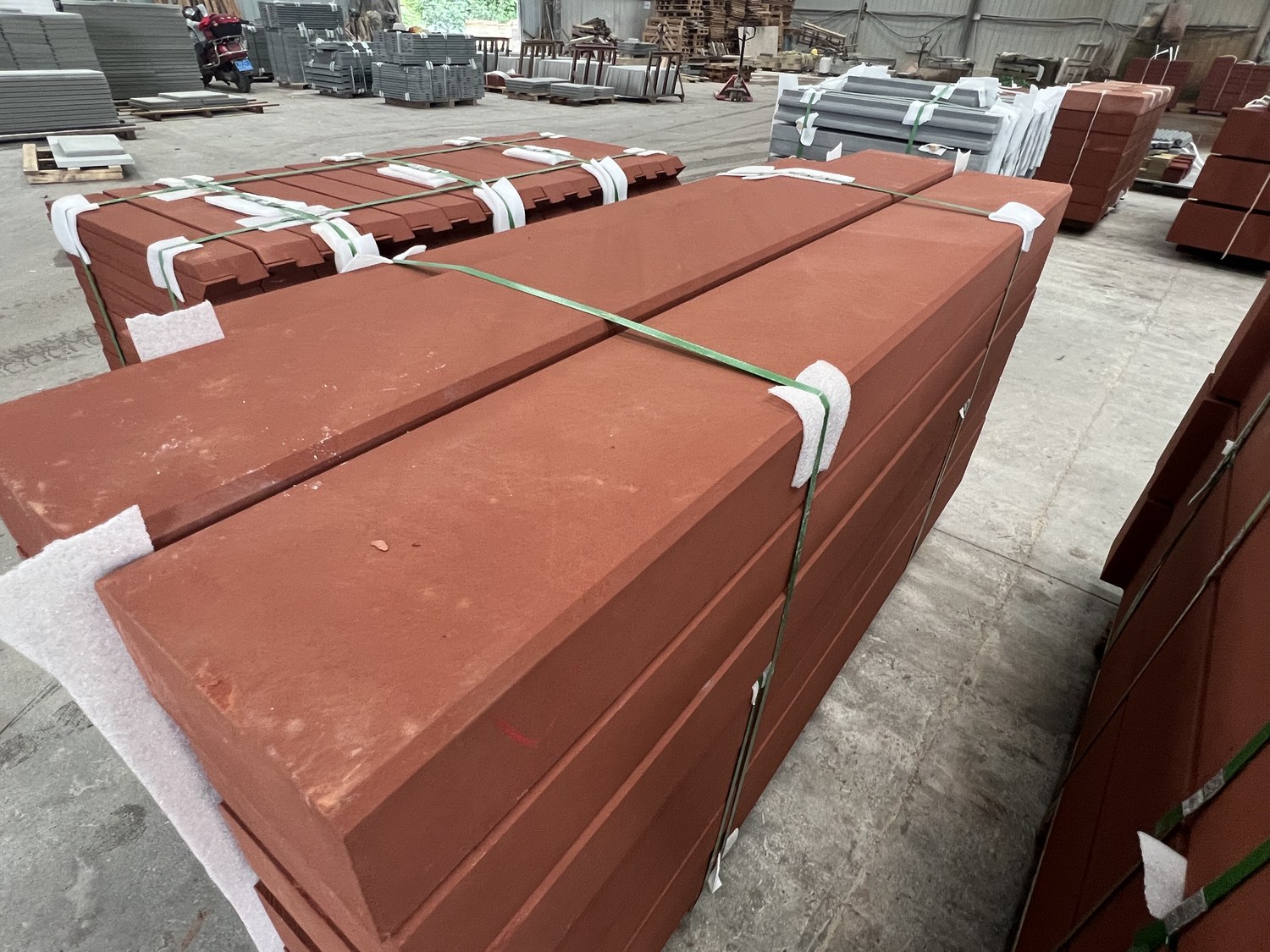
Red sandstone, packed and strapped for shipping
A deeper red sandstone, cut into kerb and coping profiles with a grooved anti-slip edge, strapped in transport-ready bundles. The colour sits at the opposite end of the range from the greys and tans shown above — the same checks on bedding, calibration and batch consistency apply regardless of which end of the range a project calls for.
Where sandstone gets specified.
Paving, cladding, pool copings, garden walls, steps and exterior detailing.
Absorption and bedding decide almost everything.
Sandstone's post-installation risks concentrate on the same two factors that decide whether it lasts: absorption and bedding. Being porous, it absorbs oil, tannin, algae growth and staining more readily than denser stone, and near pools or in humid climates that can mean visible discolouration within a couple of seasons if the wrong sealer — or no sealer — was used.
Where sandstone is laid against its natural bed rather than with it, weathering exploits that error over years, causing the surface to flake and delaminate in thin layers — a defect that traces back entirely to a cutting decision made long before installation, not to the stone's inherent quality.
In cold climates, absorbed water expands as it freezes, and freeze-thaw cycling is the reason sandstone specified for exterior paving needs a lower absorption rating than the same-looking stone used indoors. None of this is a reason to avoid sandstone outdoors — the Leshan Giant Buddha has weathered exposed sandstone through 1,300 years of Sichuan summers and winters. It's a reason to get the bedding, absorption rating and sealing strategy right before the project ships, the way that kind of longevity actually gets earned.
The other five stone families.



Not sure whether the sandstone you've chosen suits the application?
That question is cheaper to answer now than after the container arrives. Send the material reference, the application and the environment, and we'll tell you what we'd want to check.