Marble
The stone clients choose for how it looks — which is exactly what makes consistency the hardest thing to promise.

Everything that makes marble worth specifying is what makes it hard to reproduce.
Marble is calcite or dolomite that recrystallised under heat and pressure, and the same geological process that produced its colour and movement also means every block is slightly different from the next. Two slabs cut from adjacent positions in the same block can still read differently once polished, and a project spanning multiple blocks — or multiple shipments months apart — is managing that variation the whole way through, not just at the point of sample selection.
This is the material buyers are most likely to feel disappointed by after the fact: the showroom sample was accurate, the container simply wasn't uniform with it. That doesn't make marble unreliable. It means reproducibility has to be built into the process — block selection, vein-matching, batch tracking — rather than assumed from a single approved sample.
Five checks, and what each one is actually judged against.
Vein direction and continuity
Adjacent pieces are checked side by side, not against a reference photo, before cutting. Where book-matching or quarter-matching is specified, slabs are numbered in cutting sequence and their orientation recorded, so the join lines up on site rather than only in theory.
Natural fissures
Fissures are photographed and disclosed before any filling decision is made. Resin fill, epoxy fill and mesh backing solve different problems — a fill chosen to stabilise a fissure is a different decision from one chosen to hide it, and we flag which is which before it's signed off.
Colour range across blocks and batches
Each batch is checked against the approved range sample in daylight-equivalent light, not factory fluorescent tube lighting, where undertones read differently. Material outside the agreed range is set aside for a decision — not shipped and explained afterward.
Finish consistency
Polished gloss level and honed uniformity are checked panel by panel under raking light, where unevenness actually shows. A finish that looks consistent under showroom lighting can still show streaking outdoors or in direct sun.
Thickness, calibration and edge condition
Thickness and calibration are checked with a caliper across the full set, not just the first and last piece. Edges are checked for hairline cracks and chips before packing, since these are the first thing to worsen in transit.
What vein-matching actually looks like before it ships.
From the raw slab, to how it looks installed, to the factory floor work that gets it there, to the diagram that plans it — for the same black-veined marble family.
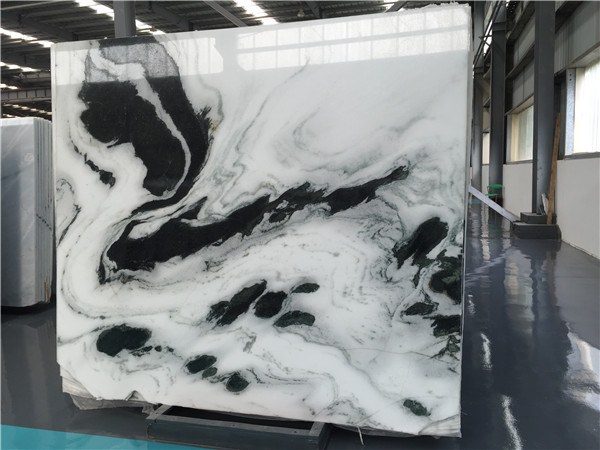
Full slab face, before any cutting
A single slab at 196×175cm. Veining density varies within the same broader marble family — a slab like this, more open and sparing, is chosen deliberately when a project calls for a quieter pattern than the dense banding on the rest of this page.
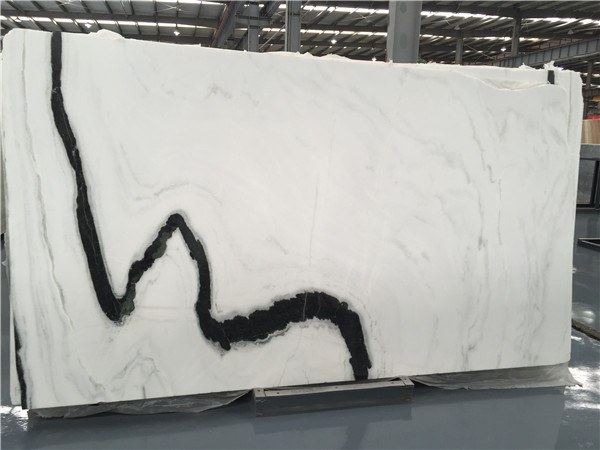
A slab reserved for one feature, not a repeat
A second full slab, 290×165cm, with a single dramatic vein running corner to corner. Slabs like this are set aside for a single feature wall or countertop where the vein is the point — not cut into repeat tile, where most of that character would be lost at the joints.
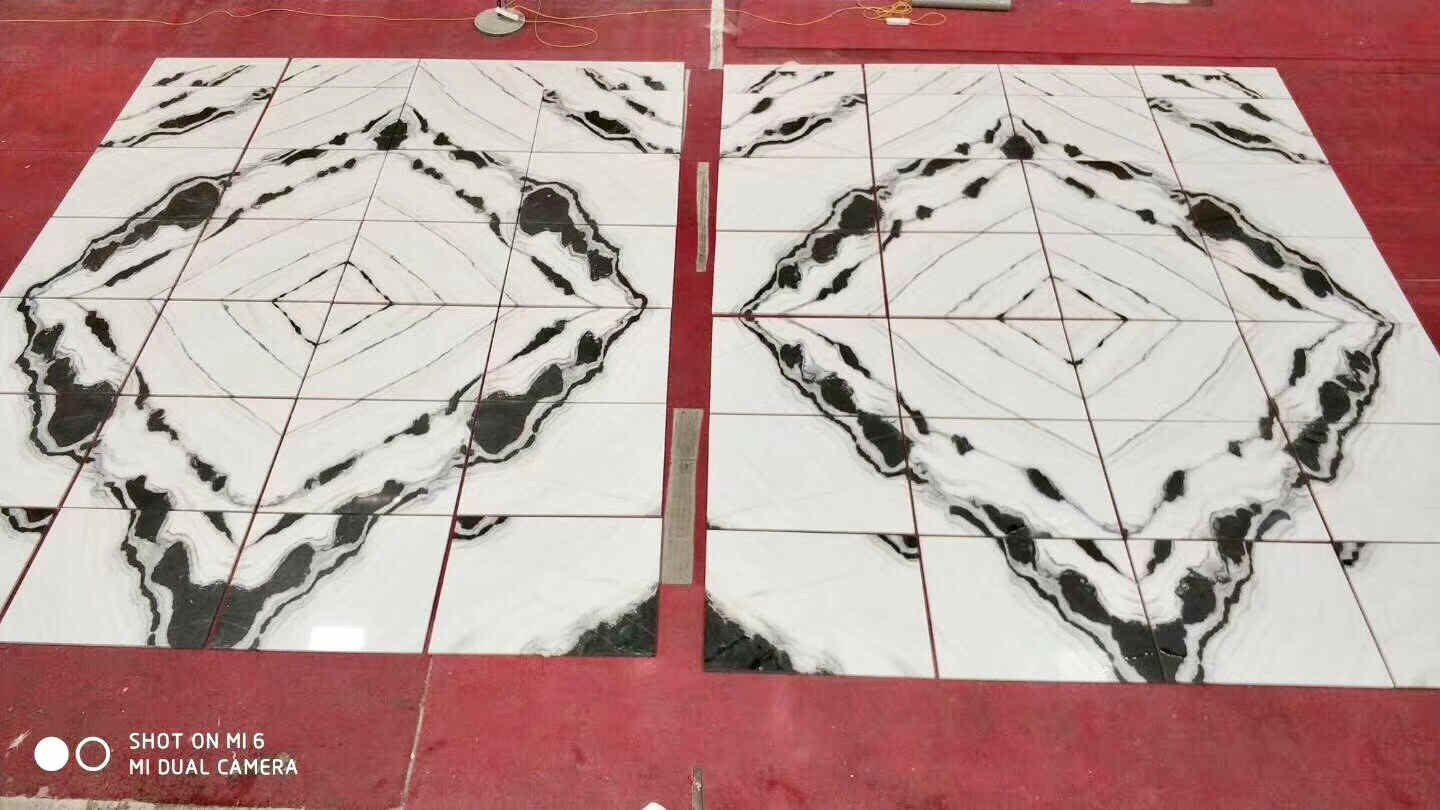
Four-way matching, taken further
The same family of marble, arranged as a four-way (quarter) match rather than a simple mirror pair — veining radiates outward from a centre point in every direction. It takes more planning than a book-match: every panel's position and rotation has to be fixed before cutting, not adjusted on site.
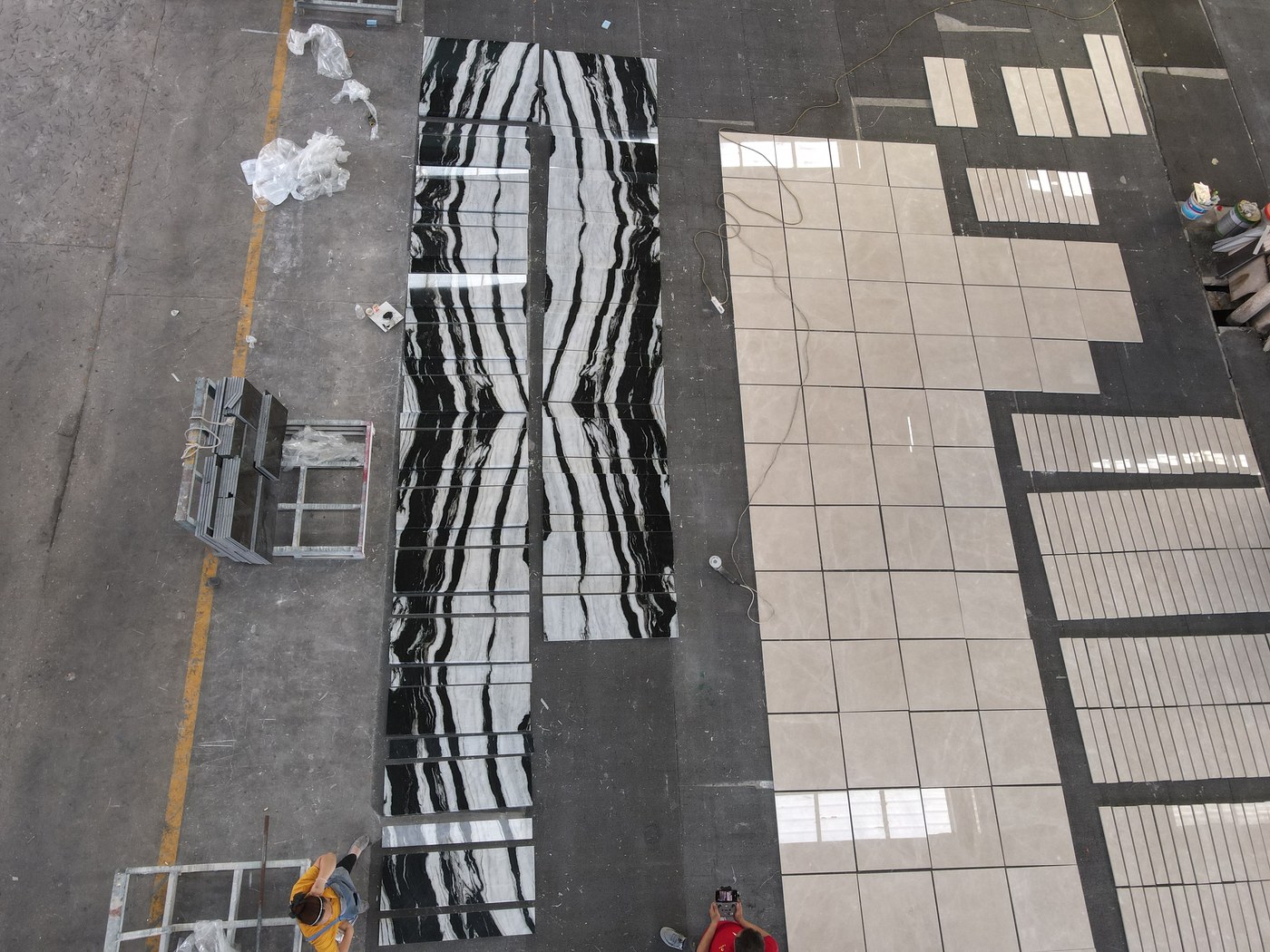
Full dry-layout before packing
Panda White marble — a black-veined white marble known for strong, continuous banding. Before this run was crated, the complete quantity was laid out on the factory floor in cutting sequence, alongside a separate beige stone run, so vein continuity and batch colour could be checked across the whole set rather than a single sample slab.
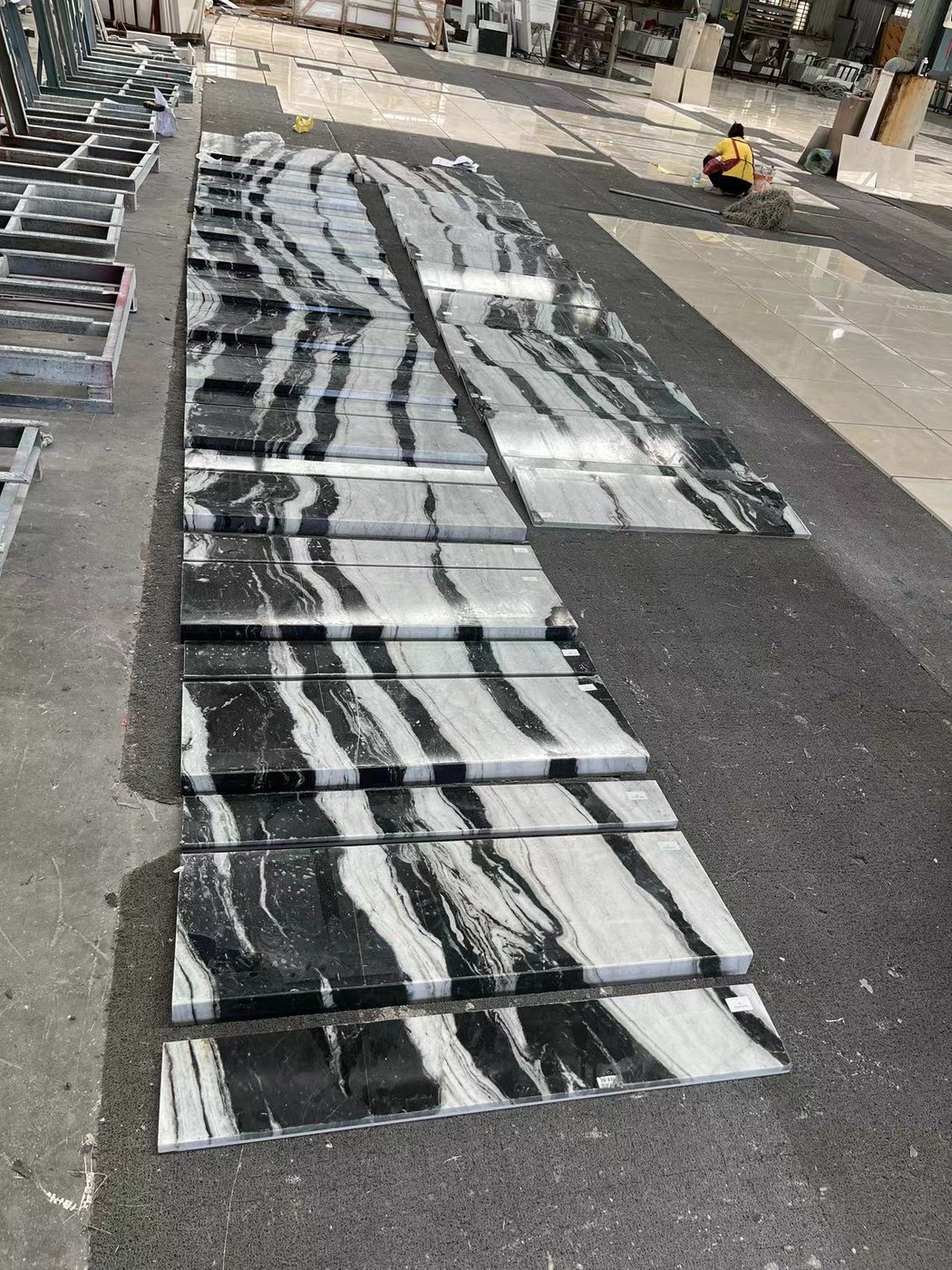
Continuity checked across the full run
The same project's cut pieces, laid out in original block order across the factory floor before shipment. Checking the run laid flat, end to end, catches a vein that drifts or a piece cut from the wrong position in the sequence — a check that isn't possible once pieces are individually crated.
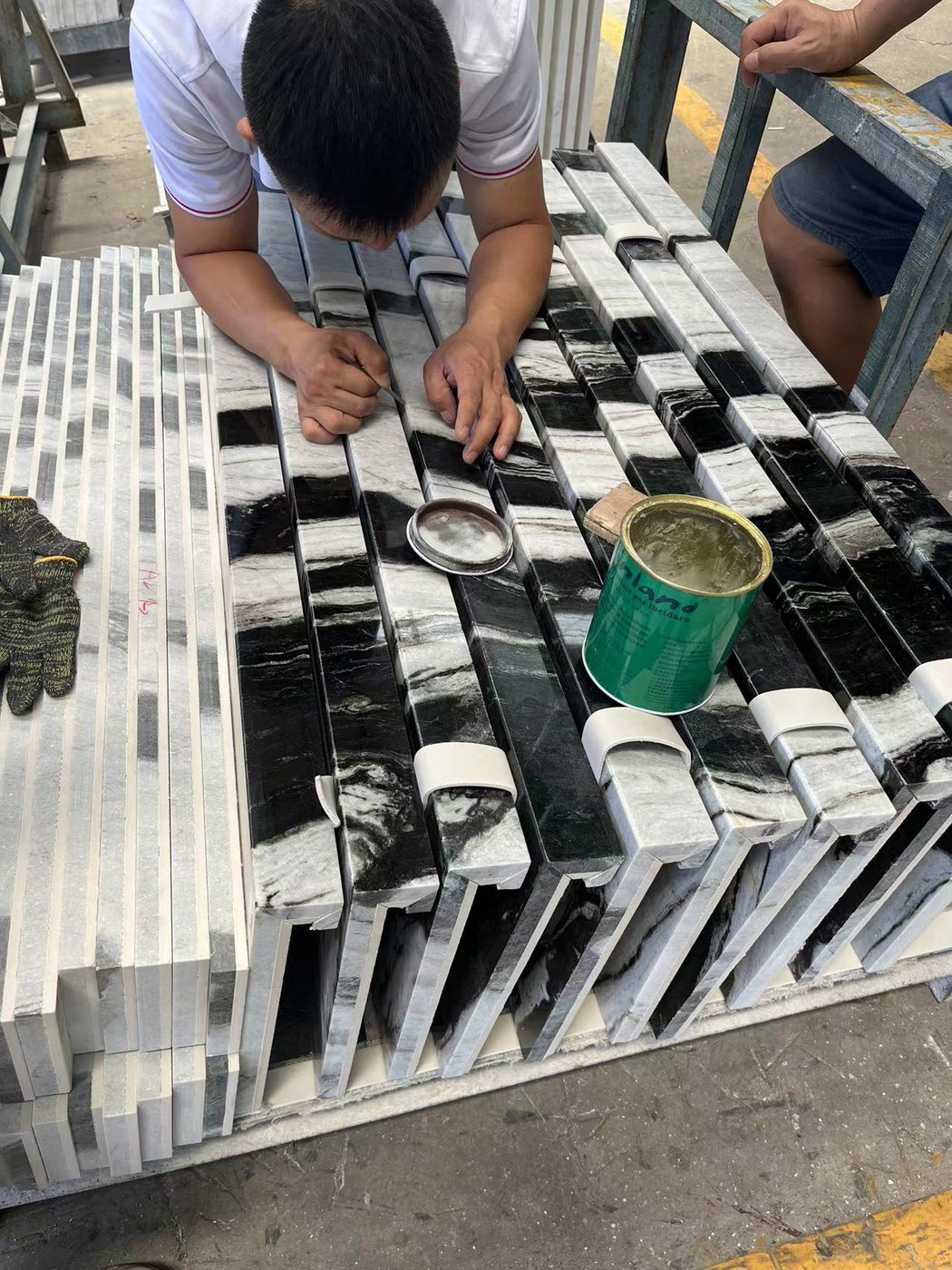
Mitred corners, fitted by hand
Skirting and trim pieces from the same run, with mitred corners hand-fitted and bonded so the vein pattern continues around the corner instead of breaking at the joint. It's a step where a well-matched set can still be let down by a careless corner — so it's checked piece by piece, not sampled.
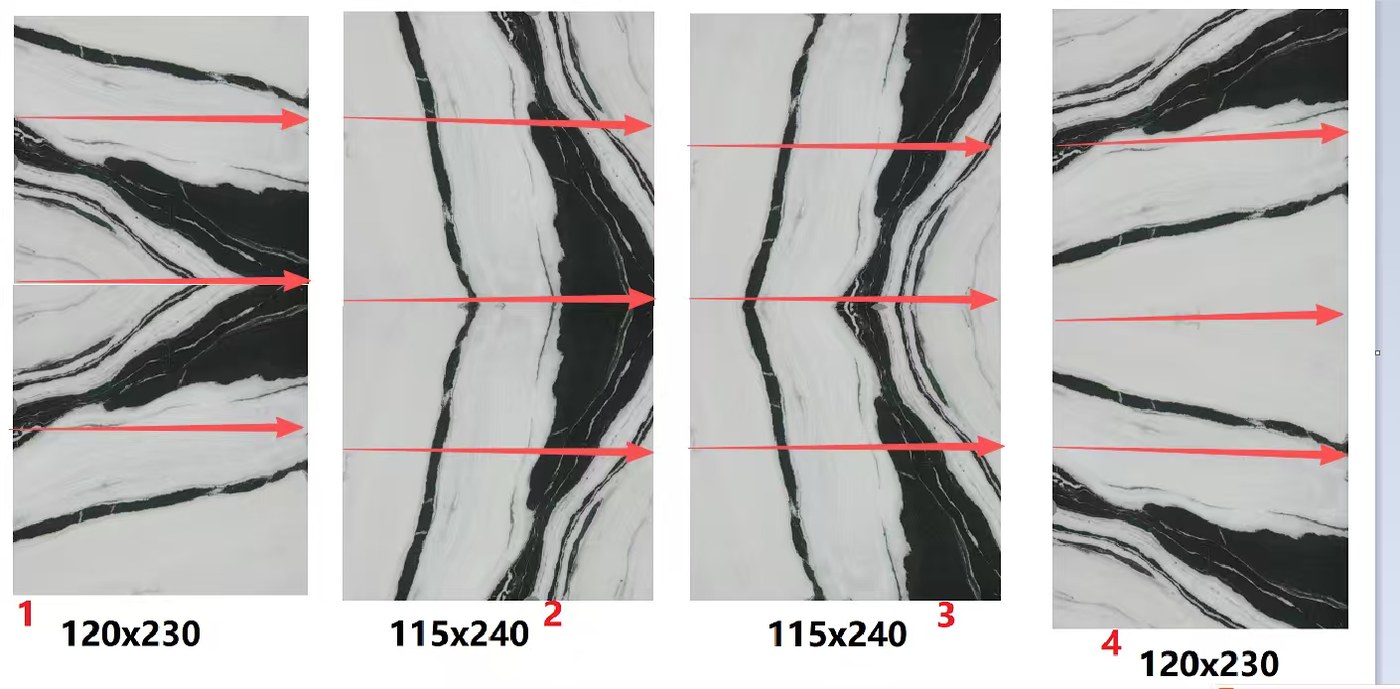
Vein-matching sequence, mapped before fabrication
The same marble, planned as a four-panel run at 120×230cm and 115×240cm. Vein direction is marked and numbered panel by panel, so the installer receives a matching diagram — not just four numbered crates. This is what stops a book-matched wall from going up out of sequence on site.
Where marble gets specified.
Flooring, wall cladding, stairs, countertops, vanities, furniture, feature walls and shaped fabrication.
The risks marble raises are mostly about surface, not structure.
Marble's main post-installation risks concentrate in two places: the surface finish, and the environment it's set into. Polished gloss dulls with foot traffic over time, and softer, calcite-rich marble etches on contact with anything acidic — wine, citrus, some cleaning products — leaving a dull mark that repolishing, not sealing, corrects.
Where marble is set in a wet area or bedded onto a cementitious substrate, salts can migrate to the surface as efflorescence — a white bloom that is usually a bedding and moisture issue rather than a defect in the stone, though the stone gets blamed regardless. And where a marble carries iron-bearing mineral inclusions — visible as darker veining in stones like the one on this page — prolonged moisture contact can bring on rust-coloured spotting that emerges from inside the material and cannot be cleaned off the surface.
None of this is a reason to avoid marble in the applications it suits. It's a reason to agree, before installation, what finish and what sealing regime the application actually needs — and to test it on a mockup rather than the finished floor.
The other five stone families.




Not sure whether the marble you've chosen suits the application?
That question is cheaper to answer now than after the container arrives. Send the material reference, the application and the environment, and we'll tell you what we'd want to check.